

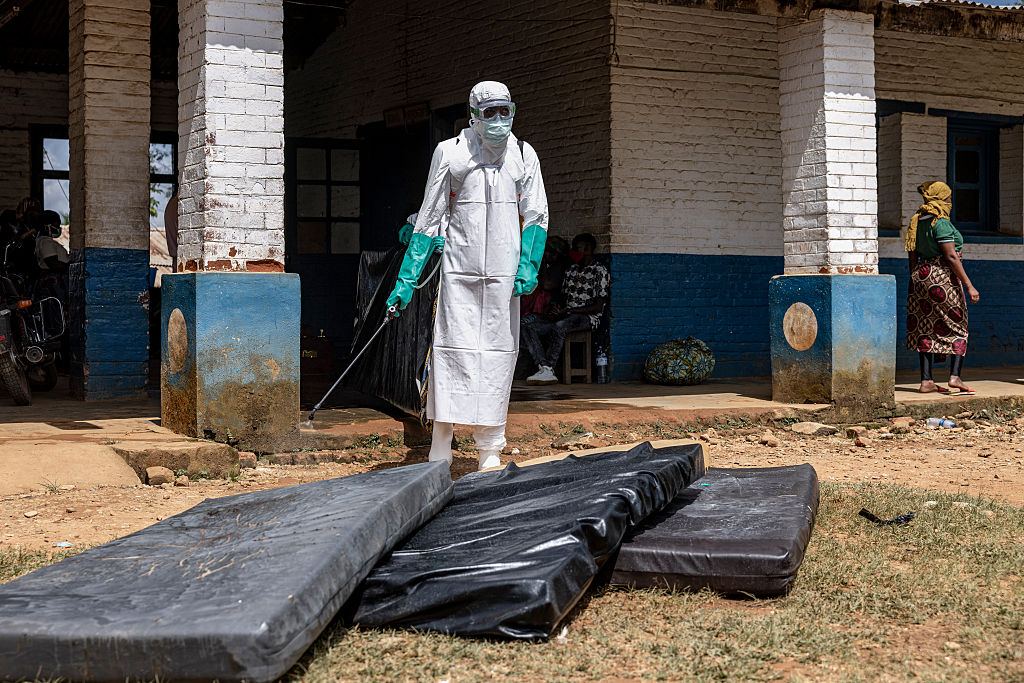
Nigeria has identified 53 contacts linked to its first confirmed case of Bundibugyo Ebola disease in more than a decade, as health authorities investigate the source of an infection detected in the capital, Abuja.
The Nigeria Centre for Disease Control and Prevention (NCDC) said Sunday that the patient, a 42-year-old woman who recently traveled from Uganda, was receiving treatment in isolation. Nigeria’s health minister Muhammad Ali Pate said in a post on X that the index patient, who he said departed Abuja for Switzerland earlier on Monday with her asymptomatic spouse, was stable, conscious and communicating, with lab results approaching baseline.
No deaths had been recorded among confirmed or suspected cases in Nigeria as of October 24, according to the agency’s latest situation report.
The 53 contacts include healthcare workers and people with household or other exposure to the patient. Authorities are monitoring contacts for 21 days after their last possible exposure, in line with the response plan outlined by NCDC Director-General Jide Idris.
The number of identified contacts increased from the 44 reported when the case was confirmed on October 20.
Loading...
“We have a clear plan,” Idris said at a briefing yesterday, adding that the immediate priorities were to identify contacts, protect healthcare workers, provide appropriate care, and prevent further transmission.
The case comes as the Bundibugyo virus outbreak in the Democratic Republic of the Congo (DRC) has spread across national borders, with infections also reported in Kenya. The World Health Organization (WHO) reported 9,704 confirmed cases and 4,687 deaths in the DRC as of October 20, while Kenya had recorded nine cases, according to its health ministry.
Nigeria confirmed its case after laboratory testing identified the Bundibugyo virus in the patient, whose symptoms began on October 7, four days after her arrival in Nigeria. She sought medical care at a private health care facility in Abuja on October 11.
Nigeria’s health minister, Muhammad Ali Pate, said genomic analysis showed that the virus in the Nigerian patient was closely related to the strain detected in Kenya’s index case, according to reports of his remarks on Friday.
Nigerian authorities have said there is no evidence that Kenya’s first patient traveled to Nigeria or had a direct connection to the Nigerian case. Investigators are examining the woman’s travel and exposure history to determine how she became infected.
Kenya’s nine reported cases have been linked to its first imported infection, with authorities reporting no evidence of wider community transmission as of the latest WHO assessment. The Kenyan index patient had traveled from the DRC through Uganda before arriving in the capital, Nairobi.
Ugandan officials have also reviewed movements through Entebbe airport as part of efforts to investigate possible links between the cases. The circumstances surrounding the infections remain under investigation.
Idris said the Nigerian case was detected after healthcare workers recognized symptoms that warranted further investigation, triggering an alert through NCDC’s event-based surveillance system.
The response includes contact tracing, laboratory testing, clinical management, hospital screening and isolation arrangements, as well as public communication intended to counter misinformation.
NCDC has urged public and private healthcare facilities nationwide to strengthen triage procedures, ensure adequate supplies of personal protective equipment, and promptly isolate and report suspected cases. Healthcare workers have been told not to wait for laboratory confirmation before implementing appropriate infection-control precautions.
The agency is also drawing on experience from Nigeria’s 2014 Ebola outbreak, when coordinated surveillance, contact tracing, and public cooperation helped contain transmission.
Nigeria’s latest situation report recorded two suspected cases during the reporting period ending October 24, one in Abuja and one in Rivers State. The suspected case reported by Rivers State tested negative for Ebola, the report said.
The outbreak presents an additional challenge because there is no licensed vaccine specifically approved for Bundibugyo virus disease.
WHO says the evidence is insufficient to determine whether Ervebo, the vaccine licensed to protect against a different Ebola virus species, provides meaningful protection against Bundibugyo infection in humans. It recommends that the vaccine be used during Bundibugyo outbreaks only within research protocols until further evidence becomes available.
In the DRC, a new vaccine trial called TUMAINI, which means “hope” in Swahili, has begun enrolling participants as researchers seek to establish whether vaccine candidates can protect against the virus, WHO Director-General Tedros Adhanom Ghebreyesus said Friday.
The Africa Centres for Disease Control and Prevention (Africa CDC) plans to convene African health ministers virtually on October 28 to assess the outbreak, strengthen cross-border coordination, and support affected countries.
Public health specialists also call for accessible testing, stronger monitoring at ports of entry, and clear communication to encourage people with possible exposure to report symptoms promptly.
Dr Chukwuebuka Ohakpougwu, a Nigerian physician and researcher, commenting on Nigeria’s case, says the country should apply lessons from its 2014 response while reassessing possible gaps in port-of-entry surveillance, contact tracing, and testing capacity.
“Measures for public containment of the virus including hand washing, social distancing, and constant communication with the public to dissuade panicking are critical at this stage,” he says to FORBES AFRICA.
Nigerian pharmacist Dr Chukwunonso Ezekwueche says governments across the region need to align to reduce the risk of further cross-border transmission.
“Countries must also share surveillance data, coordinate cross-border investigations, and engage communities to counter misinformation and encourage early reporting,” he shares with FORBES AFRICA.

